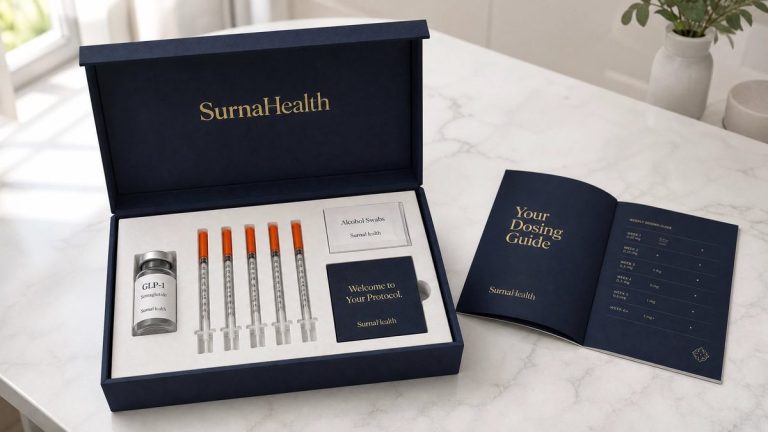
Injecting a Weekly GLP-1 at Home: What to Know
What to know about weekly GLP-1 injections at home: injection sites, rotating spots, measuring units correctly, storage and missed doses. For education only; your care team's instructions come first.
For educational purposes only. Not medical advice, and not a substitute for a visit with a licensed provider.
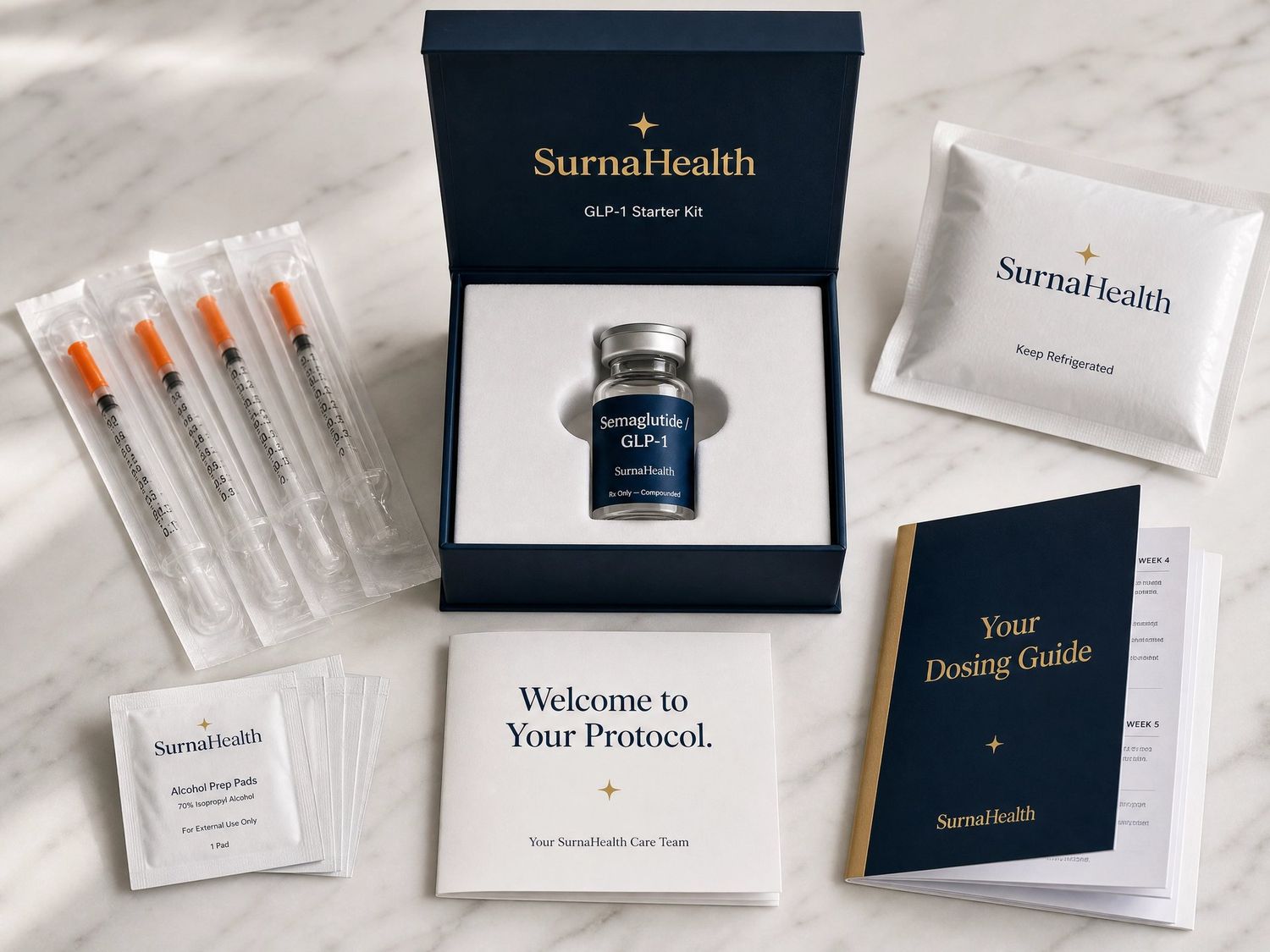
A weekly GLP-1 injection goes just under the skin of your belly, thigh or upper arm, on the same day each week, rotating spots each time. With a vial and syringe, the most important step is drawing up exactly the dose on your label, measured in the units your pharmacy specifies. Always follow your label and your provider’s instructions, which come first if anything here differs.
This overview is for education only. It does not replace the instructions and hands-on training your pharmacy and care team provide for your specific medication and syringe.
What do you need before you start?
- Your medication vial, with your name and dose on the label
- A new, unused syringe of the type your pharmacy provided
- Alcohol swabs
- A sharps container, or a heavy plastic bottle with a screw-on lid if you don’t have one yet
- A clean, well-lit surface
Check the label before every dose: the medication name, the strength, your dose and the beyond-use date. Look at the liquid. If it looks different from what your pharmacy described, such as cloudy, discolored or with particles, don’t inject it. Contact your pharmacy or care team.
Where should you inject a GLP-1?
GLP-1 medications are given subcutaneously, meaning into the fatty layer just under the skin, not into muscle. The usual sites are:
- Abdomen: anywhere on your belly at least 2 inches away from your belly button.
- Front of the thighs: the middle and outer area, between the hip and the knee.
- Back of the upper arms: this spot is often easier if someone helps you.
Avoid skin that is bruised, tender, scarred, red, hard or tattooed.
Why rotate injection sites?
Injecting into the same spot again and again can cause lumps or thickened skin, which may affect how the medication is absorbed. Change your spot each week. You can switch between areas, such as belly one week and thigh the next, or move to a new spot within the same area at least an inch from the last one. A simple note on your phone helps you keep track.
What matters when measuring a dose from a vial?
Your pharmacy and care team give you step-by-step instructions for your medication and syringe, and many people are shown the technique before their first dose. In general terms, it involves clean hands, a clean vial stopper, a new syringe each time, and drawing up exactly the amount on your label.
Units are the most common point of confusion. Most compounded GLP-1 doses are written in units on a U-100 syringe, where 100 units equals 1 mL. That means 10 units is 0.1 mL, not 1 mL.
Measuring correctly matters. The FDA has received reports of people accidentally injecting 5 to 20 times their intended dose of compounded semaglutide, often from confusing units, milliliters and milligrams. Don’t convert doses yourself. If the label, syringe or instructions don’t make sense together, stop and ask your pharmacy or care team before injecting.
What happens during the injection?
Your care team will show you how to give the injection, including the needle angle that suits your syringe. Used needles and syringes go straight into a sharps container and are never recapped, reused or shared.
A little redness or a small bruise at the site can happen. Tell your provider if a site becomes very painful, swollen, warm or hard, or if you have any signs of an allergic reaction.
How should you store your GLP-1?
- Follow the storage directions on your label. They are specific to your medication and pharmacy.
- Compounded GLP-1 vials usually need to be refrigerated, typically between 36°F and 46°F (2°C to 8°C).
- Never freeze it, and don’t use it if it has been frozen.
- Keep it away from heat and direct light. Don’t leave it in a car.
- Respect the beyond-use date. Once a vial is past that date, don’t use it, even if liquid remains.
Brand-name pens such as Wegovy® and Zepbound® have their own storage rules, including how long they can stay out of the fridge. Check the medication guide that comes with your pen.
When traveling, keep your medication in your carry-on bag in an insulated case with a cold pack, and don’t let it touch ice directly.
What if you miss a dose?
Follow the missed-dose instructions from your provider. The right answer depends on your medication and how many days have passed, and brand-name labels give different time windows for semaglutide and tirzepatide. A few general rules hold for all of them:
- Two doses should not be taken close together to make up for a missed one.
- If you have missed more than one dose, contact your care team before restarting. Your provider may restart you at a lower dose to limit side effects.
- Changing your injection day is something to plan with your provider.
Can you skip needles altogether?
Yes, in some cases. Surna offers compounded semaglutide and tirzepatide as weekly injections or as daily dissolving tablets. Injections are the most studied form, while compounded dissolving tablets have not been studied in large clinical trials, and doses do not convert one-to-one. Our injection vs. tablet comparison explains the trade-offs.
Where can you get more help?
If you are already a patient, your care team can walk you through your first injection and answer questions any time. For common questions, see our FAQ, and review the safety information for side effects and warning signs. If you are new, you can start an assessment, and a licensed provider will decide whether treatment is appropriate for you.
Sources
- U.S. Food and Drug Administration. FDA alerts health care providers, compounders and patients of dosing errors associated with compounded injectable semaglutide products (July 2024). fda.gov
- DailyMed. Wegovy® (semaglutide) injection prescribing information and instructions for use. dailymed.nlm.nih.gov
- DailyMed. Zepbound® (tirzepatide) injection prescribing information and instructions for use. dailymed.nlm.nih.gov
- U.S. Food and Drug Administration. Best way to get rid of used needles and other sharps. fda.gov
This article is general information, not medical advice. Always follow your label and your provider’s instructions. Compounded medications are prepared by state-licensed pharmacies and are not FDA-approved. Wegovy® is a registered trademark of Novo Nordisk and Zepbound® of Eli Lilly and Company; Surna Health is not affiliated with either.