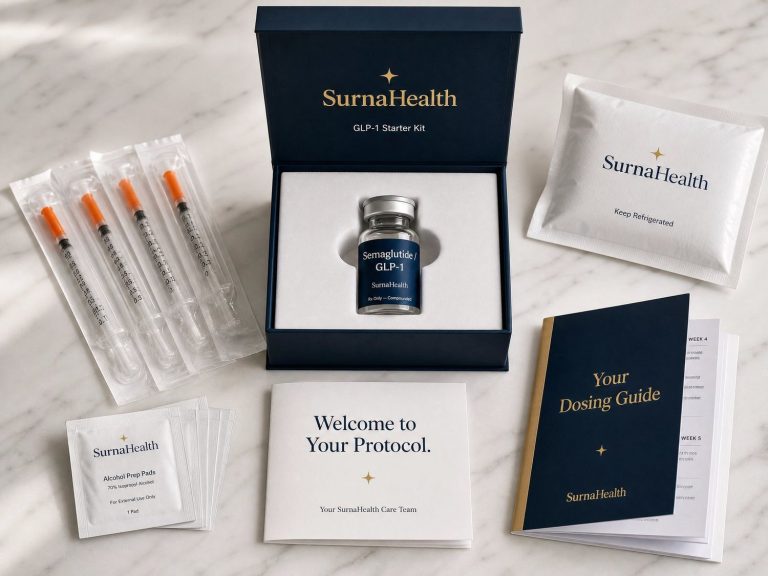
What Is Compounded Semaglutide? How It Differs From Brand-Name GLP-1s
Compounded semaglutide and tirzepatide are prepared by state-licensed pharmacies and are not FDA-approved. How they differ from Wegovy® and Zepbound®, and how to spot a legitimate source.
For educational purposes only. Not medical advice, and not a substitute for a visit with a licensed provider.
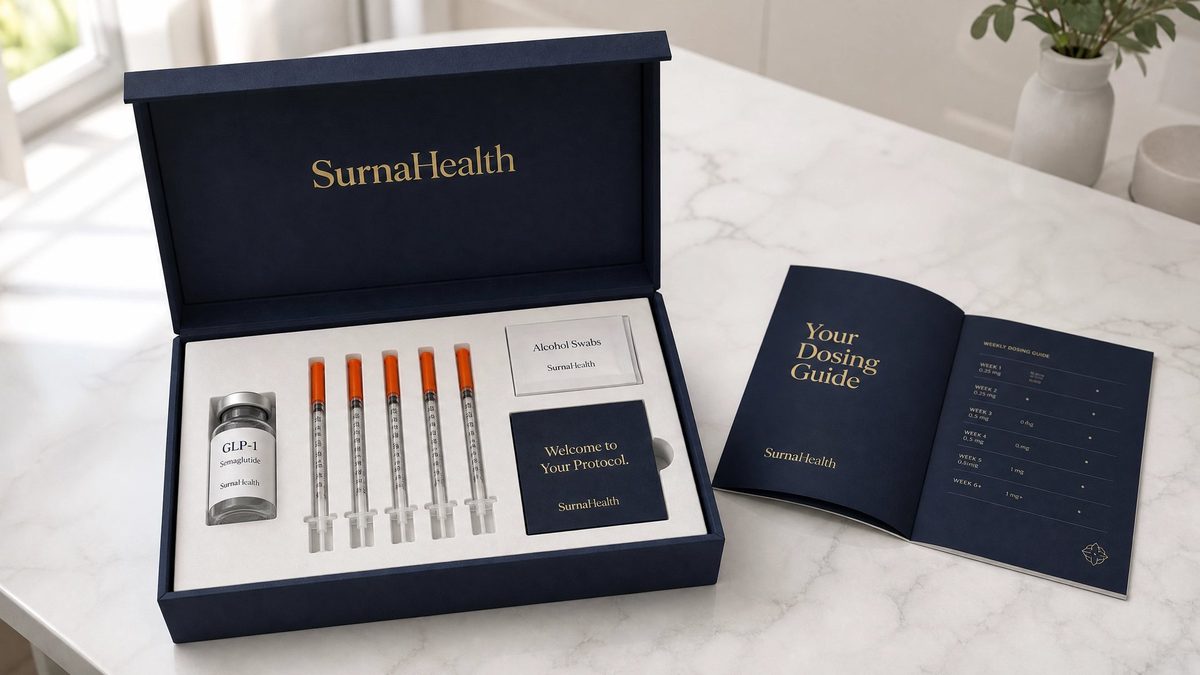
Compounded semaglutide and compounded tirzepatide are versions of these GLP-1 medications prepared by a licensed pharmacy for an individual patient’s prescription. They are not FDA-approved, and they are not the same products as Wegovy® or Zepbound®. A legitimate source always requires a prescription from a licensed provider and dispenses from a state-licensed pharmacy named on your label.
What does “compounded” mean?
Compounding is when a pharmacist combines, mixes or adjusts ingredients to make a medication for a specific patient. It has a long, legitimate history: think of a liquid version of a pill for someone who can’t swallow tablets, or a medication made without an ingredient a patient is allergic to.
Because compounded drugs are made for individual patients, they do not go through the FDA approval process. The FDA does not review their safety, effectiveness or quality before they are dispensed. That is the central difference from a brand-name medication.
How is compounded semaglutide different from Wegovy®?
| Wegovy® / Zepbound® | Compounded semaglutide / tirzepatide | |
|---|---|---|
| FDA-approved | Yes | No |
| Made by | Novo Nordisk / Eli Lilly | A state-licensed compounding pharmacy |
| Studied in large clinical trials | Yes | The compounded products themselves have not been |
| Typical form | Prefilled pen, or the Wegovy® pill | Multiple-dose vial and syringe, or a compounded tablet |
| Insurance | Sometimes covered | Generally self-pay |
The active ingredient may share a name, but the finished product is different: different manufacturer, different formulation, different oversight. The large weight loss trials you may have read about, such as STEP 1 for semaglutide and SURMOUNT-1 for tirzepatide, studied the FDA-approved medications. Their results do not transfer automatically to compounded versions. Our compounded vs. brand-name comparison lays this out side by side.
Is compounded semaglutide legal?
Licensed pharmacies can compound medications for individual patients under federal and state rules. For most patient-specific compounding, that happens under section 503A of the Federal Food, Drug, and Cosmetic Act, with state boards of pharmacy licensing and inspecting the pharmacies. Larger “outsourcing facilities” operate under section 503B and register with the FDA.
Those rules are narrower than many people realize. Pharmacies are generally not allowed to compound copies of a commercially available FDA-approved drug on a routine basis. During a drug shortage, that limit loosens, which is why compounded GLP-1s became so widely available in 2023 and 2024.
What happened when the GLP-1 shortages ended?
The FDA listed both semaglutide and tirzepatide injections on its drug shortage list for an extended period. Then:
- Tirzepatide: the FDA determined the shortage was resolved on October 2, 2024, and reaffirmed that decision on December 19, 2024, after re-evaluating it. It gave state-licensed 503A pharmacies until February 18, 2025, and 503B outsourcing facilities until March 19, 2025, to wind down compounding that relied on the shortage.
- Semaglutide: the FDA determined the shortage was resolved on February 21, 2025, with wind-down periods ending April 22, 2025, for 503A pharmacies and May 22, 2025, for 503B outsourcing facilities.
Since then, the rules for compounding these medications have been tighter. Compounding can still happen in limited circumstances, such as when a prescriber determines a patient needs a formulation that differs meaningfully from the approved product. Regulators have also warned companies that market compounded GLP-1s as the same as, or equivalent to, the brand-name drugs. The rules have changed more than once, and availability can change again.
Are compounded GLP-1s safe?
Compounded and brand-name GLP-1s share the same class of side effects and warnings, including the boxed warning about thyroid C-cell tumors seen in rodent studies. Our safety information page lists them in full.
Compounding adds two risks of its own. First, quality depends on the pharmacy, since the FDA does not review the product before it is dispensed. Second, compounded injections usually come in multiple-dose vials, and the FDA has received reports of dosing errors, including people drawing 5 to 20 times their intended dose because of confusion between milliliters, milligrams and syringe “units.” Follow your label and your care team’s instructions exactly.
How can you tell a legitimate source from a research-chemical seller?
Websites selling semaglutide or tirzepatide labeled “for research purposes only” or “not for human consumption” are not pharmacies. Their products are not prescribed, not dispensed for a named patient and not made under pharmacy oversight. The FDA has warned about unapproved and counterfeit GLP-1 products sold online, and about products made with the salt forms semaglutide sodium and semaglutide acetate, which are not the active ingredient in FDA-approved semaglutide.
A legitimate source will:
- Require a prescription. A licensed provider reviews your health history before prescribing, and can say no.
- Name the pharmacy. The dispensing pharmacy appears on your label, and you can look up its license with your state board of pharmacy.
- Label the product for you. Your name, the medication, its strength and directions are on the vial or bottle.
- Explain the dose in plain terms. You should know exactly how much to take and how to measure it.
- Say clearly that it is not FDA-approved. Anyone calling a compounded GLP-1 “generic Wegovy®” or “the same as Zepbound®” is making a claim regulators have specifically warned about.
- Offer follow-up care. Someone should be reachable if you have side effects or need a dose change.
Red flags: no prescription required, no pharmacy named, “research use only” labels, unusually low prices paid through payment apps, or vials shipped without a patient label.
What does Surna offer?
At Surna, compounded semaglutide and tirzepatide are prescribed only if a licensed provider finds them appropriate, and are dispensed by state-licensed pharmacies named on your label. Brand-name options are available too. Compounded semaglutide starts at $109/mo and compounded tirzepatide at $139/mo, with provider care included and shipping added at checkout. If you’re unsure which way to go, a provider can help after you complete an assessment. Individual results vary.
Sources
- U.S. Food and Drug Administration. FDA clarifies policies for compounders as national GLP-1 supply begins to stabilize. fda.gov
- U.S. Food and Drug Administration. FDA’s concerns with unapproved GLP-1 drugs used for weight loss. fda.gov
- U.S. Food and Drug Administration. Compounding and the FDA: questions and answers. fda.gov
- U.S. Food and Drug Administration. FDA alerts health care providers, compounders and patients of dosing errors associated with compounded injectable semaglutide products (July 2024). fda.gov
- Wilding JPH, et al. Once-Weekly Semaglutide in Adults with Overweight or Obesity (STEP 1). N Engl J Med. 2021;384:989-1002. nejm.org
- Jastreboff AM, et al. Tirzepatide Once Weekly for the Treatment of Obesity (SURMOUNT-1). N Engl J Med. 2022;387:205-216. nejm.org
This article is general information, not medical advice. Compounded medications are prepared by state-licensed pharmacies and are not FDA-approved. Wegovy® is a registered trademark of Novo Nordisk and Zepbound® of Eli Lilly and Company; Surna Health is not affiliated with either.