
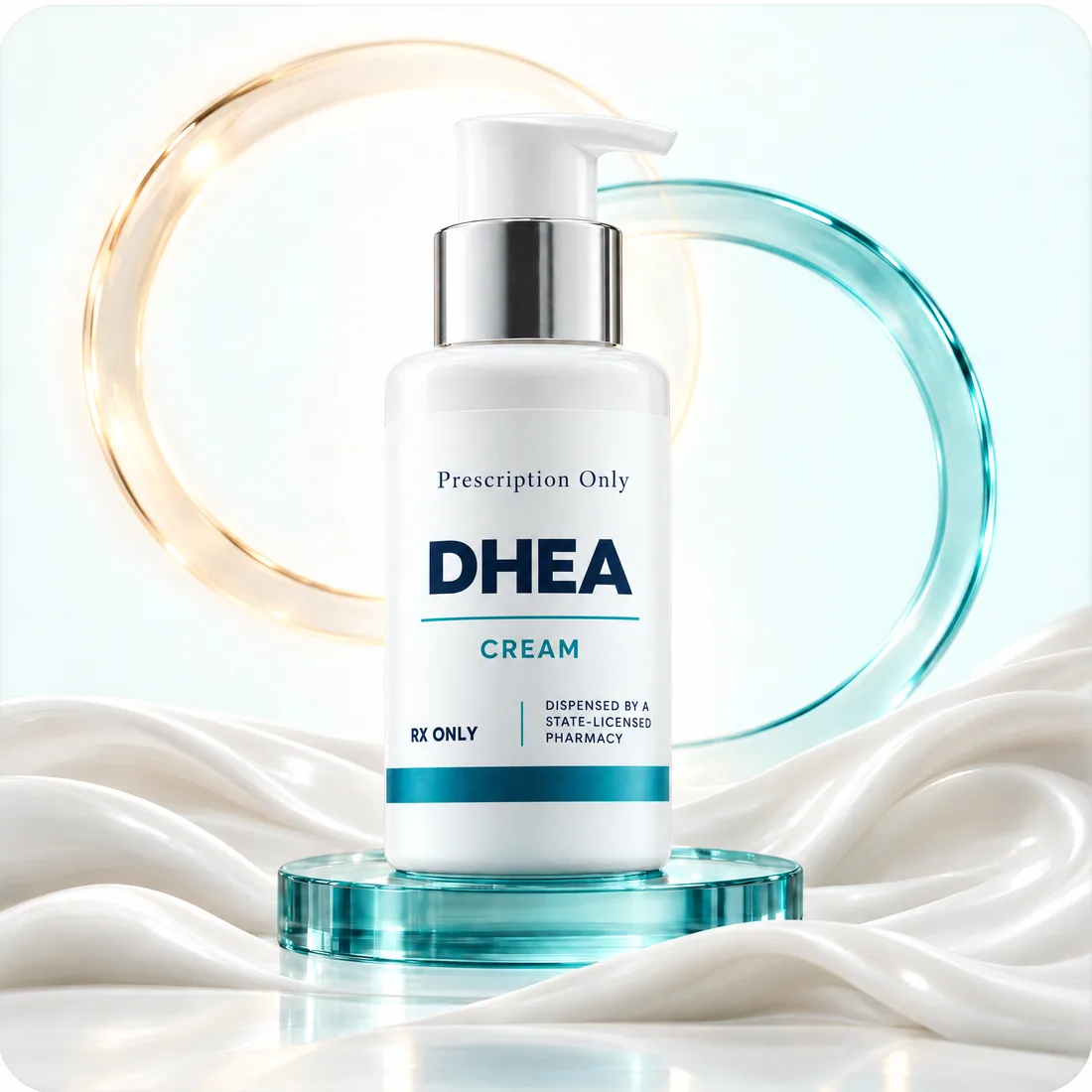
 Prescription only
Home / Anti-Aging & Longevity / DHEA Cream
DHEA Cream
Prasterone (DHEA). Prescribed after a provider review.
Anti-Aging & Longevity
Compounded topical DHEA.
- Form
- Topical cream, daily
- Licensed providers
- Pharmacy named on every label
- 12-month price lock
Quick answer
DHEA Cream at a glance
DHEA (dehydroepiandrosterone) is a hormone produced by your adrenal glands that serves as a building block for both testosterone and estrogen.
How it’s taken: topical cream, daily.
A prescription from a licensed provider is required.
Updated
How DHEA Cream works
DHEA (dehydroepiandrosterone) is a hormone produced by your adrenal glands that serves as a building block for both testosterone and estrogen.
Levels peak in your mid-20s and decline steadily with age.
Restoring DHEA levels can improve energy, libido, mood, and overall hormone balance in both men and women.
The cream form absorbs through your skin and avoids the liver metabolism issues associated with oral DHEA.

What DHEA is
A compounded bioidentical preparation. FDA has raised concerns specifically about marketing compounded hormone preparations as safer or more natural than approved products. We do not make that claim, and you should be sceptical of anyone who does.
An adrenal precursor
DHEA is produced by the adrenal glands and is a precursor the body converts to other steroid hormones.
Declines with age
Levels are reported to fall with age. That is an observation about a population, not a diagnosis for you.
Compounded, not approved
This compounded preparation is not an FDA-approved drug product.
Prescribed from labs
Whether it is appropriate depends on bloodwork your provider orders and reads.
DHEA Cream questions
Can I just buy DHEA over the counter?
OTC DHEA supplements are available, but they're unregulated and doses are often inaccurate. Prescription compounded DHEA is made to exact specifications and tested for potency.

See if DHEA Cream is right for you.
Answer a few questions and a licensed provider will review your options.
Start your assessmentImportant safety information
Last updated
Testosterone is a Schedule III controlled substance.
Prescribing it is subject to DEA telemedicine rules and state controlled-substance requirements in addition to ordinary standards of care.
Compounded hormone preparations, including compounded testosterone, Biest, progesterone and thyroid preparations, are not FDA-approved drug products.
Estriol is not a component of any FDA-approved drug.
Testosterone therapy requires baseline and ongoing laboratory monitoring.
Your provider determines what testing is required and when.
Reported risks include erythrocytosis, effects on fertility and spermatogenesis, worsening of sleep apnoea, acne, and cardiovascular considerations your provider will review against your history.
Not appropriate in pregnancy, in anyone who is or may become pregnant, or where a provider identifies a contraindication such as active prostate or breast malignancy.
FDA has raised concerns specifically about marketing compounded hormone preparations as safer or more natural than approved products.
We do not make that claim and you should be sceptical of anyone who does.
Compounded medication, prepared by a state-licensed pharmacy for individual patients. Compounded drugs are not FDA-approved, and the FDA does not review them for safety, effectiveness or quality. Prescribed only if your provider determines it is clinically appropriate for you.
This is not a complete list of risks. Talk with your provider and read the full prescribing information or medication guide.